.jpg)
Automated background checks for transport, logistics, and ports
The transport, logistics, and port sector is critical infrastructure and serves as a gateway for trade, supply chains, and passenger transport. With the EU Ports Strategy, as well as the NIS2 Directive and CER Directive, requirements for risk management, personnel security, and access control are tightening. This increases the need for documented control over who has access to critical facilities and systems. P-Secure digitises the entire process — from hiring to continuous re-checks — with full traceability and in compliance with GDPR.
Transport and logistic companies that use our platform





Compliance challenges in transport, logistics, and ports
Transport, logistics, and port operators must manage a large number of employees, suppliers, and partners across organisations and complex supply chains. At the same time, documentation must be up to date, consistent, and readily available as accurate, traceable, and audit-ready for authorities and regulators. In practice, this creates significant compliance challenges.
The sector is characterised by:
- Numerous external actors with temporary or recurring access to secured areas and facilities
- Port and operations staff with access to critical systems and physical infrastructure
- Subcontractors and freight forwarders with access to secured port facilities and supply chains
- Ongoing hiring and an increasing need for re-checks
This increases the risk of inconsistency, manual errors, and time-consuming administration related to controls, re-checks, and documentation. A key challenge is that authorities currently provide high-level guidance without specifying detailed requirements — leaving organisations to interpret obligations without clear legal frameworks and creating internal uncertainty regarding proportionality and necessity.






Key features for transport, logistics, and ports
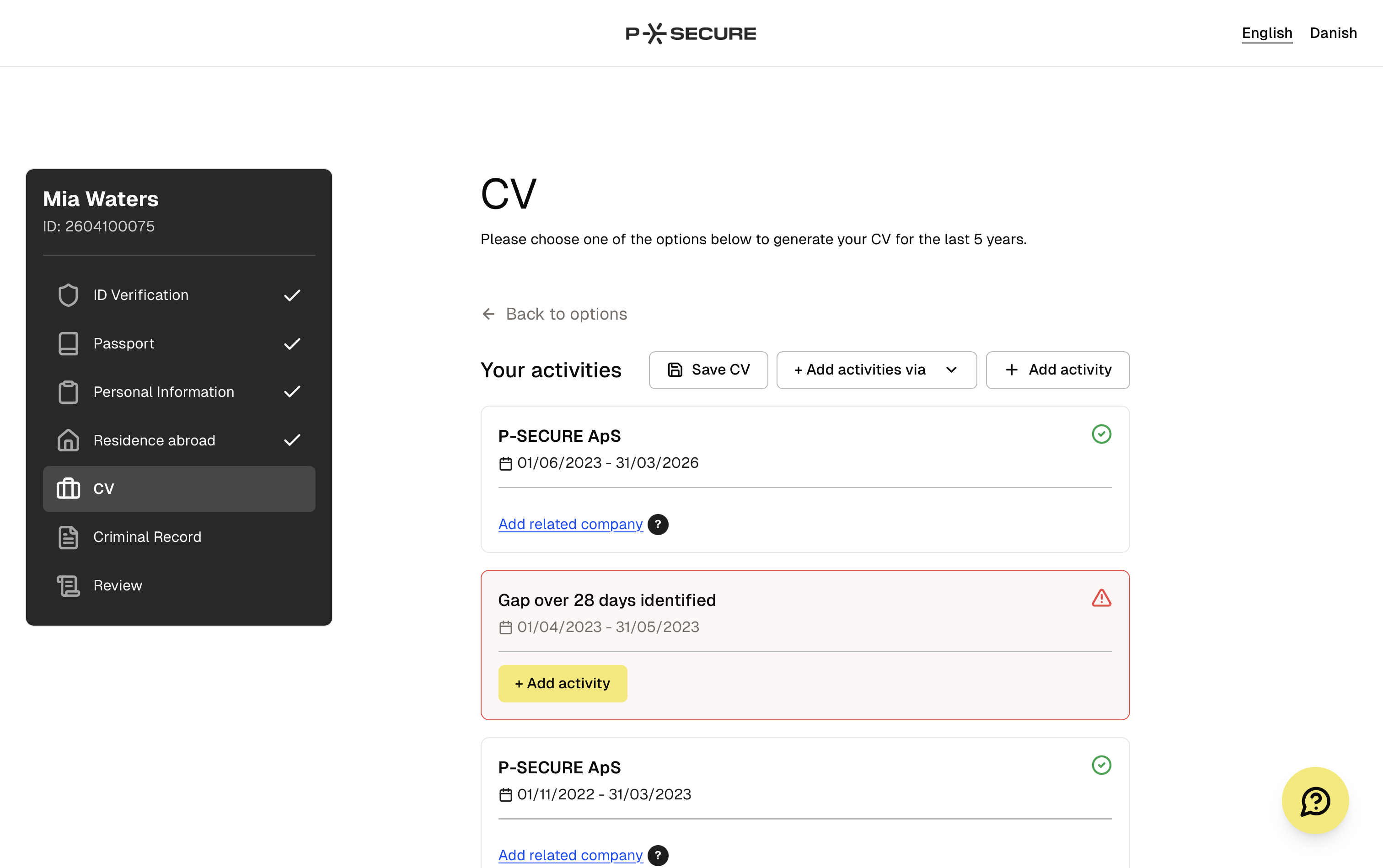
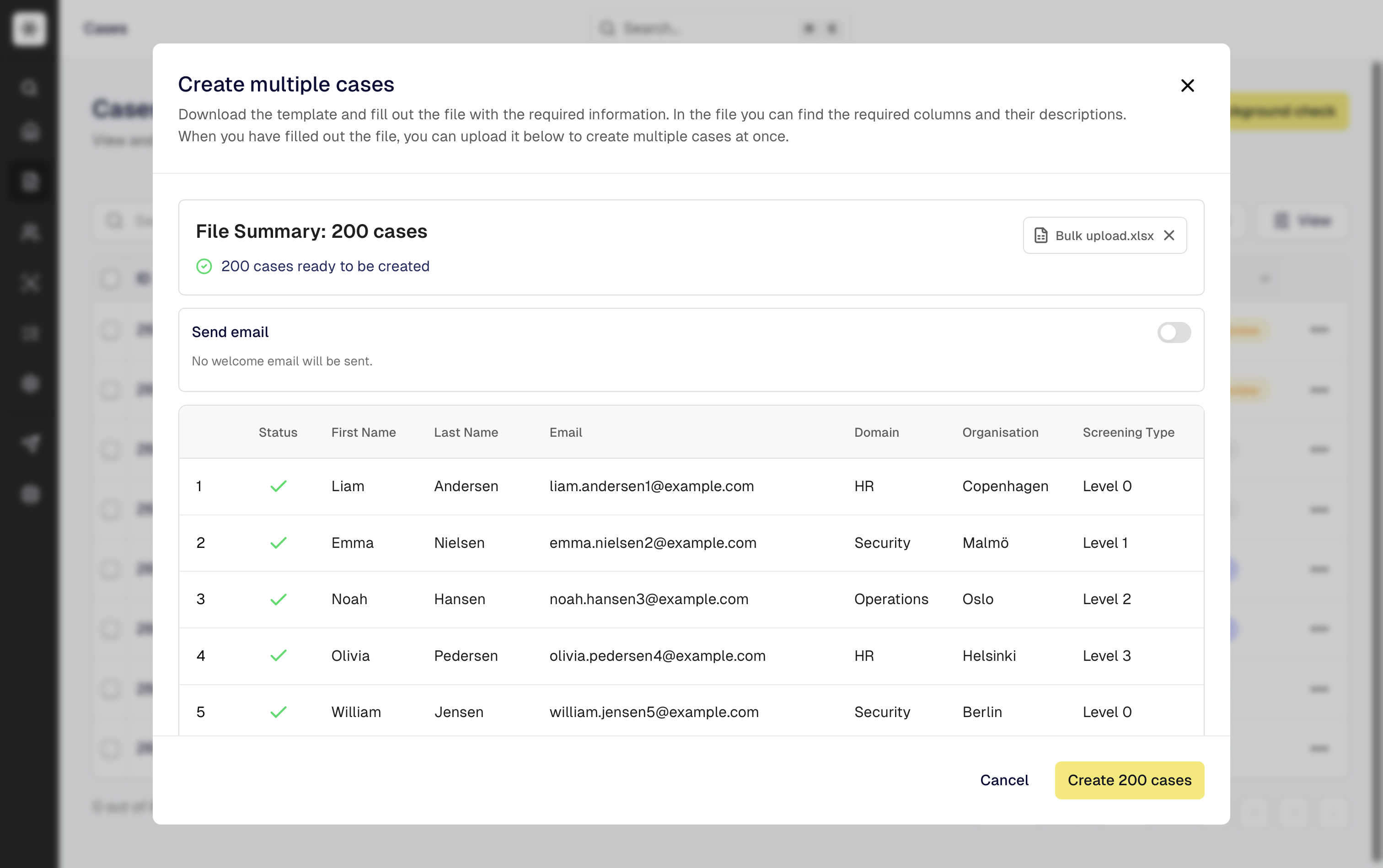
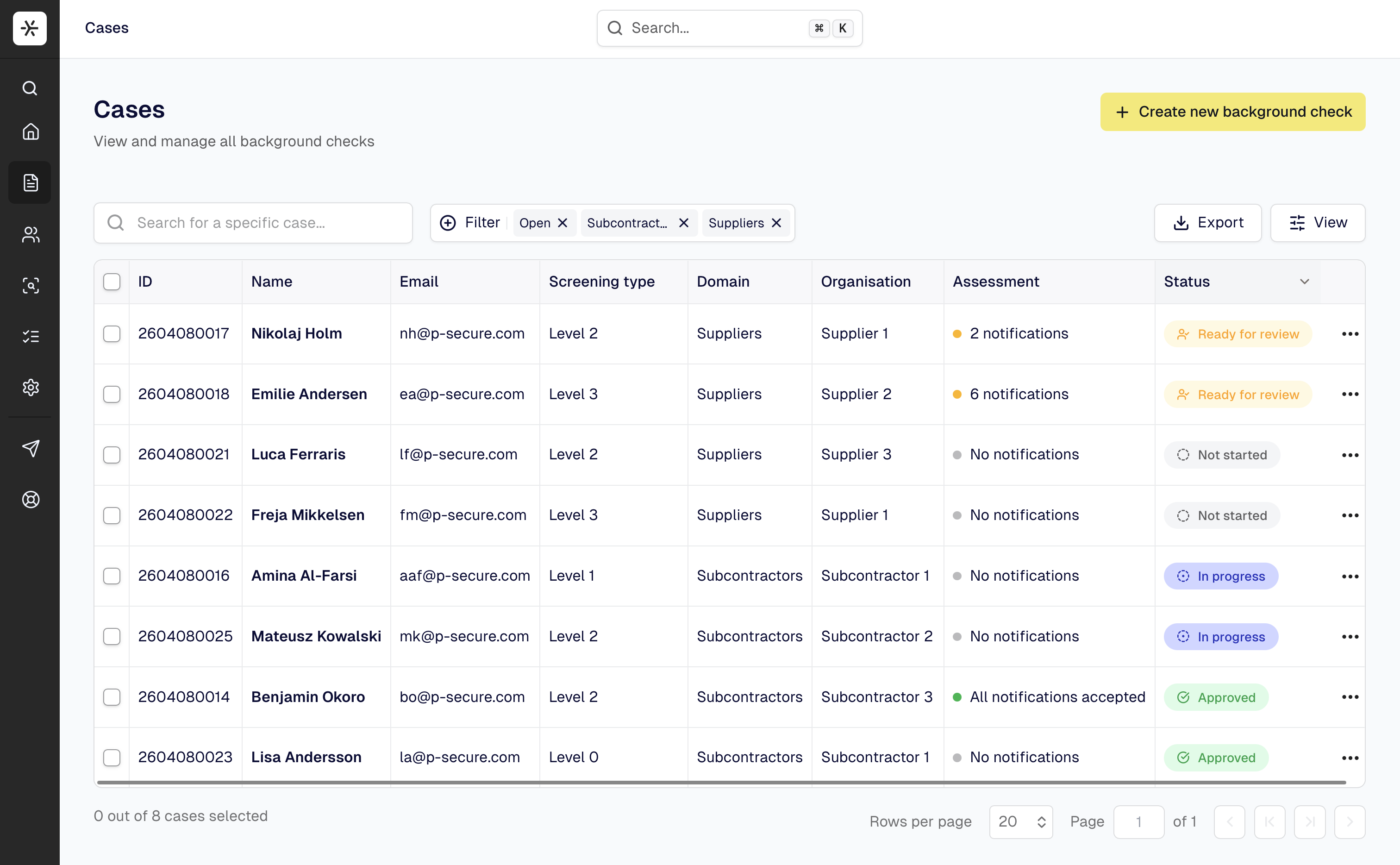
P-Secure automates the verification of identity, CV, driving licences, residence permits, and criminal records — ensuring precise, timely controls and reducing the risk of human error, even when large numbers of staff need to be screened simultaneously.
ID and CV check
Identity verification and CV checks, including employment history and gaps
Driver's license
Driving licence verification where relevant to the role
Document verification
Verification of work and residence permits
Criminal record checks
Upload and check of the candidates criminal record
Recommended screening categories for background checks
In collaboration with stakeholders in the transport and logistics sector, P-Secure is working to establish a common standard for screening and background checks that can be applied across transport and logistic companies. Download our recommended screening categories for the transport and logistics sector.
Regulatory framework and P-Secure’s recommendations
For ports, current regulation is based on the ISPS Code (International Ship and Port Facility Security Code), implemented in Danish law through Executive Orders no. 1282–1283/2020 on port facility security. These rules impose requirements for access control and personnel security in secured port areas, but the specific requirements are defined in each facility’s Port Facility Security Plan (PFSP).
As in the aviation sector, the ISPS Code requires background checks — but whereas aviation operates with explicit regulatory categories, the port sector leaves the scope to the individual facility.
Industry stakeholders are increasingly calling for enhanced background screening in Danish ports, aligned with the aviation model. In the lead-up to the authorities’ designation of critical entities on 17 July 2026, there is a clear need for defined, sector-specific requirements based on the existing aviation framework established by Trafikstyrelsen.
At present, regulatory requirements for critical entities remain limited.
Requirements for critical entities:
- Identity verification (CER Directive)
- Criminal record checks (CER Directive)
Security clearance
Where roles require security clearance, P-Secure recommends conducting pre-screening of candidates prior to application — in line with practices in the energy sector. This reduces both risk and processing time and alleviates pressure on the clearance system by filtering out candidates who are unlikely to be approved.
Based on best practices from the energy and aviation sectors, P-Secure further recommends a structured and scalable approach to background checks, where the scope can be expanded in line with increasing regulatory requirements.
P-Secure recommends the following minimum elements:
- Identity verification
- CV verification — typically at least five years, including documentation of gaps
- Criminal record checks
- Driving licence verification for roles involving transport or equipment operation
- Work and residence permit verification
This provides a comprehensive, risk-based decision-making framework that can be adapted to employees, new hires, suppliers, and subcontractors. P-Secure supports compliance with both NIS2 Directive and CER Directive, and brings together personnel processes, case management, audit, GDPR compliance, and organisational resilience in a single solution.
The need for modern background screening
Implement automated and compliant background checks
Requirements for security, documentation, and resilience in the transport, logistics, and port sector continue to increase. At the same time, organisations relying on manual or fragmented processes face growing pressure.
Benefits of automated background checks:
Reduce administrative workload
Shorten onboarding time
Improve transparency and consistency
Strengthen audit and internal controls
Ensure continuous compliance
Apply across employees and the supply chain
Continuous compliance
More than a one-time background check
P-Secure is not just a tool for one-off background checks, but a platform for continuous compliance:
- Ensures compliance with NIS2, CER, and relevant national requirements
- Centralises all documentation — ready for audit and inspection
- Supports risk-based re-checks and access management
- Ensures GDPR compliance


Secure your workspace today



SKI 02.14 It-konsulenter (Dynamisk Indkøbssystem)